
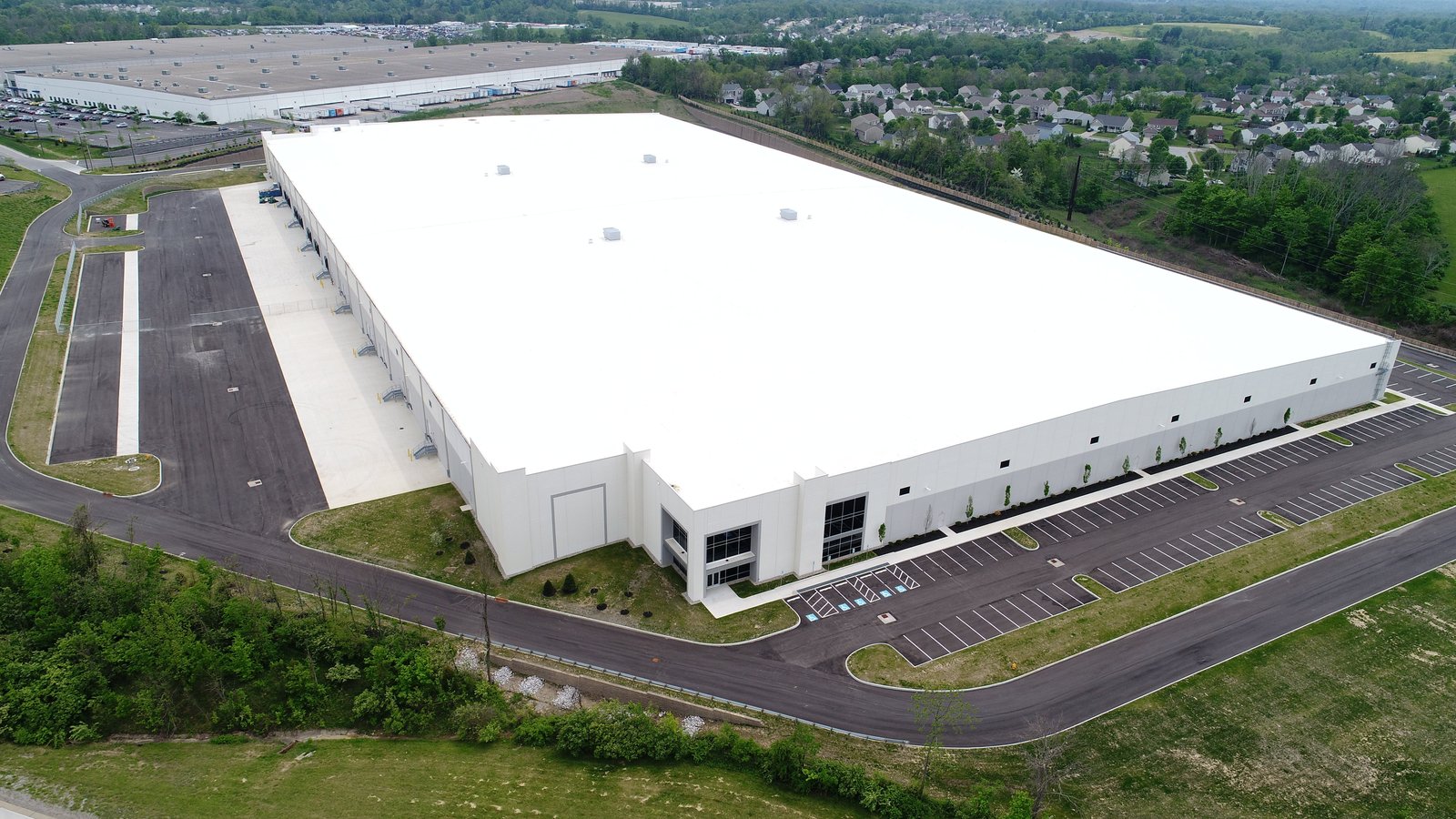
Distribution Center Construction Along the I-25 Corridor
Distribution centers on the I-25 and BNSF corridor from Walsenburg to La Junta: dock walls, truck courts, slabs and sprinklers sized to your throughput.
- Category
- General Contracting Services
- Area
- Pueblo and southern Colorado
- Next Step
- Request a Project Review
Forty-eight miles of Interstate 25 separate Pueblo from Walsenburg, and another 36 run on to Trinidad. Between those points a distributor can run freight north toward the Front Range, south toward the pass and east down the Arkansas Valley, with BNSF and Union Pacific rail available in the metro. That geography is why shippers look at this corridor, and it is why we think about distribution centers as freight problems first and buildings second.
A distribution center is a machine for turning pallets around. The building needs the right number of dock doors, the right depth of truck court, a slab that survives forklifts running hot, and a layout where product does not cross paths with itself. We build them from the ground up, starting with the site and the trucks, because the shell is the cheap part to get right and the expensive part to get wrong.
If your project is smaller or more general-purpose, look at warehouse construction. If it involves picking, packing and parcel, our notes on fulfillment and logistics centers cover that variation.
Sites along the corridor
Pueblo is the center of the corridor, but the options extend both ways. Walsenburg sits on the eastern edge of I-25 with US 160 passing through its center, and it is 72 miles from Alamosa via US 160. Trinidad lies at the foot of Raton Pass and is a junction of three BNSF subdivisions. La Junta carries BNSF freight between Denver and Kansas and Texas, with US 50 running through it and US 350 and Colorado Highway 10 beginning there.
Each place has a different draw. Pueblo gives the largest labor pool and the most site choices, Walsenburg gives I-25 frontage with a smaller footprint, Trinidad gives a rail junction at the pass, and La Junta gives east-west reach on the BNSF line. We help owners compare them on construction cost and on how trucks and trains will actually reach the dock.
What the metro offers a distributor
Pueblo's freight network is simple to describe. Interstate 25 and US 85 share one route through the city, US 50 carries traffic east and west, and BNSF and Union Pacific both serve the area. Pueblo Memorial Airport adds a full-service municipal field about 5 miles from I-25, with 40 acres available for development.
That mix lets owners pick the distribution model that fits. A regional parcel hub, a bulk consolidation point or a cross-dock for logistics and distribution operators each leans on different parts of the network. We do not choose your model for you. We build the one you choose and tell you what it costs.
From truck court to roof
Distribution projects include a large share of exterior work. Truck courts must carry heavy axle loads and repeated turning movements, so they are often reinforced concrete, not asphalt. Dock aprons, trailer parking, drainage and lighting add up to a large part of the budget. Our truck courts and dock aprons page details how we design and place that concrete.
Inside, we build the slab to the flatness the material handling system requires, the structure to the clear height, and the sprinkler system for the commodity class. Dock equipment includes levelers, seals and bumpers, and we coordinate with the supplier early because doors and levelers are a lead-time item.
Throughput drives the plan
Start with the number of trucks per hour at peak. That sets the dock count, the truck court depth, the number of trailer stalls and the queue length at the gate. Owners often underestimate the yard, and a building with too few trailer positions chokes on its own success. We run the numbers with the operator before the shell is drawn. If the operator is not chosen yet, we use a conservative assumption, label it clearly and show how the plan changes if the real number is higher.
Trailer parking and the gate deserve the same care. A long queue of idling trucks backs onto the public road, and the county or city will want to see a stacking plan. We lay out the gate, the guard position and the stacking length with a traffic engineer where the site calls for one, because a plan that works on paper can fail at 6 a.m. on the first Monday after opening.
Automation is the next question. Conveyors, sortation or racking systems can change the floor loads, the column spacing and the electrical load. If automation is planned, even for a later phase, we build the infrastructure for it: heavier slab, more power capacity and space for equipment. It is far cheaper to prepare than to retrofit.
What else the job needs
Most distribution projects start on raw land. Site development and utilities covers grading, water, sewer, power and stormwater, and the schedule for those items often controls the project. We handle the civil work along with the building so that one team owns the interface.
Some owners want cold or temperature-controlled space added to the building. The structure and slab of a cooler differ from a dry box, and that is covered on our page for cold storage construction. If you tell us early, we can leave room.
Plan the dock and the yard first
Send us your throughput numbers, your site options and your target date. We will return a layout, a budget and a schedule.
Questions Owners Ask
How many dock doors do I need?
Throughput matters more than floor area. We ask for peak trucks per hour and dwell time, then count doors from that. Extra doors can be added later if the building is designed with knock-out panels, so we usually build for the doors you need now and leave panels where the next ones would go. A door count that matches the operation beats a long wall of doors that nobody uses.
Is concrete or asphalt better for the truck court?
Concrete lasts longer under heavy, turning loads and doesn't rut like asphalt. It costs more up front and is common in dock aprons. We price both and show lifecycle costs.
How big a site do I need?
Count the building, the trailer parking, the truck circulation and the stormwater detention. A distribution center often needs a site considerably larger than the building footprint. We can test a layout on the parcel before you buy it.
Can you build near the rail line?
Yes, but a rail spur involves the railroad, its engineering and its schedule. We coordinate the track design with the carrier and keep it off your critical path where possible. BNSF and Union Pacific both serve Pueblo, and BNSF reaches Trinidad and La Junta.
What about retail-supply distribution?
Retail chains often want a regional distribution center with fast access to stores. We design to the chain's standards, adapt to local code and review the standards for anything that does not fit this market.