
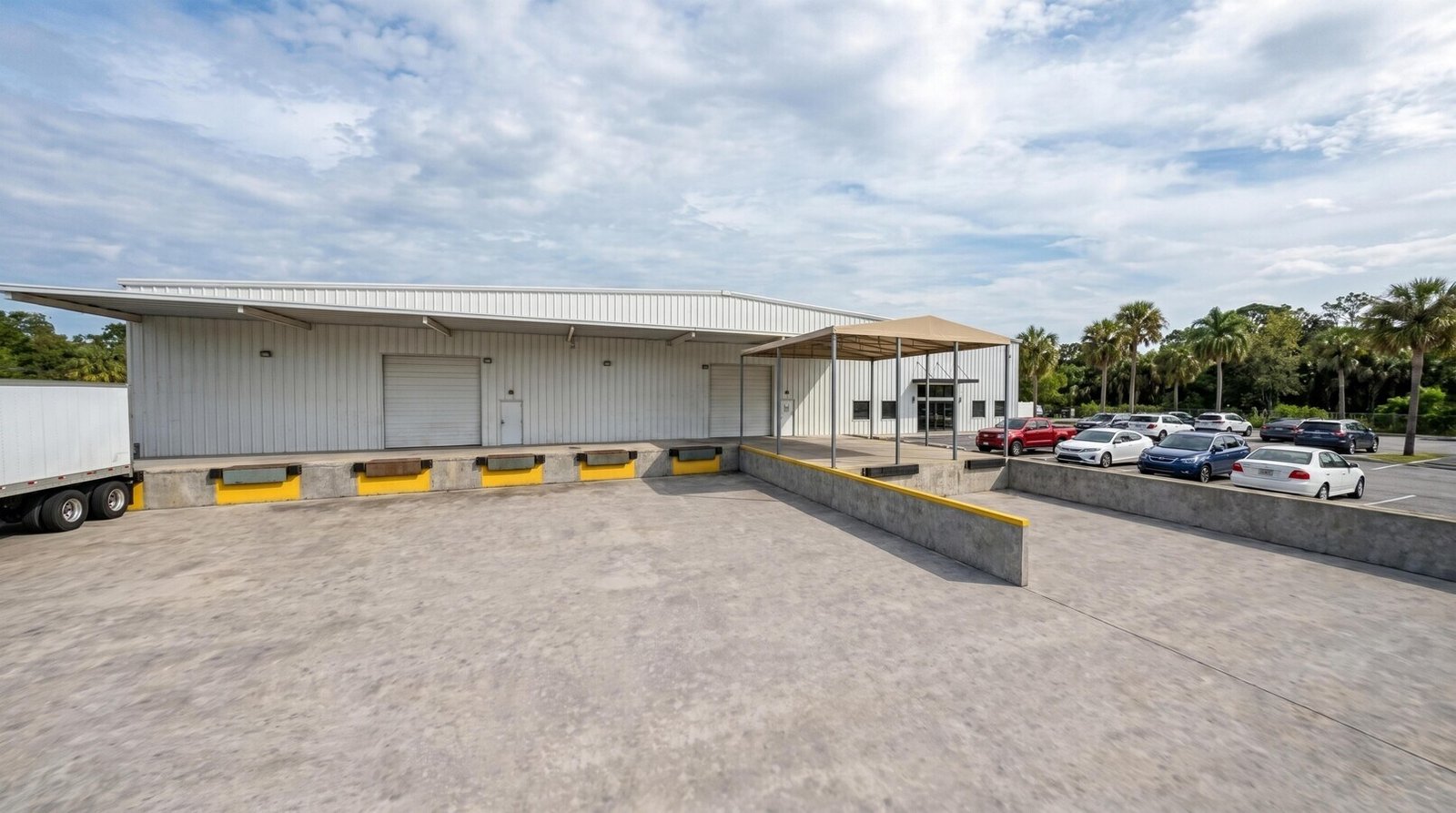
Truck Courts and Dock Aprons in Pueblo
Truck courts, concrete dock aprons and trailer staging built for Pueblo freight routes, with tested subgrade, doweled joints and drainage that works.
- Category
- General Contracting Services
- Area
- Pueblo and southern Colorado
- Next Step
- Request a Project Review
Where a loaded trailer turns, the pavement fails first. A truck court takes the hardest punishment on any industrial site: tight turns, standing loads on landing gear, braking at the dock and the same lanes used all day by every carrier. Asphalt rutting, shoved joints and cracked aprons are not bad luck. They come from a design that did not match the traffic or a build that cut a corner under the surface.
We build truck courts, dock aprons, trailer staging and the approaches that feed them. That includes the subgrade, base, pavement section, reinforcing, joints, drainage and the striping and bollards that keep drivers where they should be. We usually pour the high-stress zones in concrete and use asphalt where the traffic is lighter, and we explain the reasoning rather than pushing one material.
Pueblo gives an owner several ways to get freight in and out: interstate, US highways and two railroads. We lay out courts so that trucks arrive from those routes, queue without blocking public streets and reach the dock without a three point turn. If a site plan does not work for a 53 foot trailer, we say so before the concrete is ordered, and we suggest changes the civil engineer can accept.
What decides the layout
Start with the truck. A 53 foot trailer with a tractor needs a specific turning envelope, and a court depth that is too short makes backing slow and unsafe. The typical industrial court for full-size trailers is deeper than most people expect, and the extra depth is cheap compared to the land it takes on a new site. We check turning paths early and mark them on the plan for your review.
Then ask about the dock. How many doors, what kind of levelers, and will trailers be dropped and left? Dropped trailers put landing gear loads on a small area, which is a concrete job. Equipment such as dock levelers need pits and thickened edges that we pour with the apron. Slopes at the approach should not exceed what the equipment allows, and drainage should send water away from the dock, not toward it. A dock that floods in a storm or ices in the winter is a safety problem.
Freight routes the court has to serve
Interstate 25 and US 85 run together on one north-south route through Pueblo, US 50 runs east-west through the city, and freight rail is provided by both BNSF and Union Pacific. The city lists the St. Charles Industrial Park as an Opportunity Zone with rail freight access. For a distributor or manufacturer, that mix of highway and rail makes a Pueblo site workable for both truck and carload freight.
Closer to the edges of the metro, Pueblo West has a North Industrial Park linked to I-25 by the US 50 corridor, and the airport side of town is reached from the SH 47 and US 50 interchange on the State Highway 47 corridor. Which route your carriers use determines where the main gate should face and how long the entry drive needs to be. We look at the real approach roads, intersections and signals, not just the lot lines, before we settle the court geometry.
How we build a court that lasts
The work starts below the surface. We proof roll the subgrade, correct soft spots and place the engineered base in lifts with density testing. A dock apron is only as good as what is under it. For concrete sections, we place dowels at joints, set reinforcing where the design calls for it and finish for a surface that sheds water and gives tires traction. For asphalt sections, we control mix temperature, compaction and joint construction because the seams are where water gets in.
We pour dock aprons in panels sized to the joints in the building slab, so cracks do not wander. Curing and joint sealing finish the job. At the end we paint the stripes, install bollards, wheel stops and signage and walk the court with your operations lead to check turning paths with an actual truck if you can arrange one. Drainage ties into parking lot construction next door, so one contractor handles both and the slopes agree.
Who we build them for
Most truck court work comes from logistics and distribution operators, manufacturers shipping finished goods and retailers receiving store freight. A truck terminal or cross-dock puts the heaviest demand on pavement, with continuous movement at doors on both sides of the building. A cold storage facility adds ice and condensation at doors, which changes slab and drainage details.
Developers building speculative industrial space ask us to design a court that will work for whoever leases it. That means conservative depth, enough door positions and an apron section heavy enough for dropped trailers even if the first tenant does not use them. We help owners decide how much to build now and what can be added later, so you are not overbuilding for a tenant who may never arrive or under-building for the one who does.
Where the court falls in the sequence
The truck court cannot be finished until the building slab, dock equipment and underground utilities are done, but the base can be prepared early so crews are not starting from scratch. We build the base after utilities, protect it from construction traffic, and pave after the heavy trucks hauling steel and precast have gone. Paving over a base that has been cut up by a month of concrete trucks is a mistake we avoid.
Weather matters here more than anywhere else on a site. Asphalt needs warm, dry days, and concrete needs temperatures that let it cure. When schedule forces paving into cold months, we adjust the mix and the process. Where a tenant needs to move in before the pavement can be finished, we build a temporary access, sequence the work to keep the dock usable and plan the final lift for when the weather allows. A permit that requires a final inspection of the paving can hold the certificate of occupancy, so we plan this around those dates.
Put your truck on the site plan
Send us the layout, the trailer type and the door count and we will check turning paths, pavement sections and cost before you commit to the plan.
Questions Owners Ask
Should a dock apron be concrete or asphalt?
Concrete is the usual choice at the dock and in staging areas where trailers sit with landing gear down and tires turn tightly. Asphalt works in drive lanes and light traffic areas and costs less up front. Your civil engineer will set the section from the traffic. We price both and help you see where each makes sense.
How deep should the truck court be?
It depends on the trailer, the door spacing and whether you want trailer parking along the edge. Deeper courts are safer and faster to work. We check turning paths on your site plan and suggest changes early, since adding depth after the building is placed is very expensive.
Can you build the apron while the building is occupied?
Yes, if we plan the phasing. We build in sections so some doors stay open, install temporary barriers and keep a clear route for drivers. It is slower than a clean site, and we price it that way.
What does winter do to a dock apron in this area?
Freeze and thaw cycles, deicing chemicals and standing water attack concrete and joints. Good drainage, proper air entrainment in the mix, sealed joints and a gentle slope away from the dock all help. We specify those details to protect your investment over the long run.
Do you coordinate with the dock equipment supplier?
Yes. Leveler pits, bumpers and shelters have exact dimensions, and the supplier needs a pit that is square, dry and the right depth. We get the shop drawings, verify the pit layout before the pour and invite the supplier to check it.