
Parking Lot Construction in Pueblo
Parking lot paving, mill and overlay and full rebuilds for Pueblo retail, hospital and campus properties, phased so your site stays open.
- Category
- General Contracting Services
- Area
- Pueblo and southern Colorado
- Next Step
- Request a Project Review
Pueblo Mall covers 575,000 square feet on a single floor, and a building that wide lives or dies by its parking. Customers judge a property from the curb before they reach the door. Potholes, ponding, faded stripes and a lot that floods in a thunderstorm tell them how the owner runs the place, and tenants hear about it quickly.
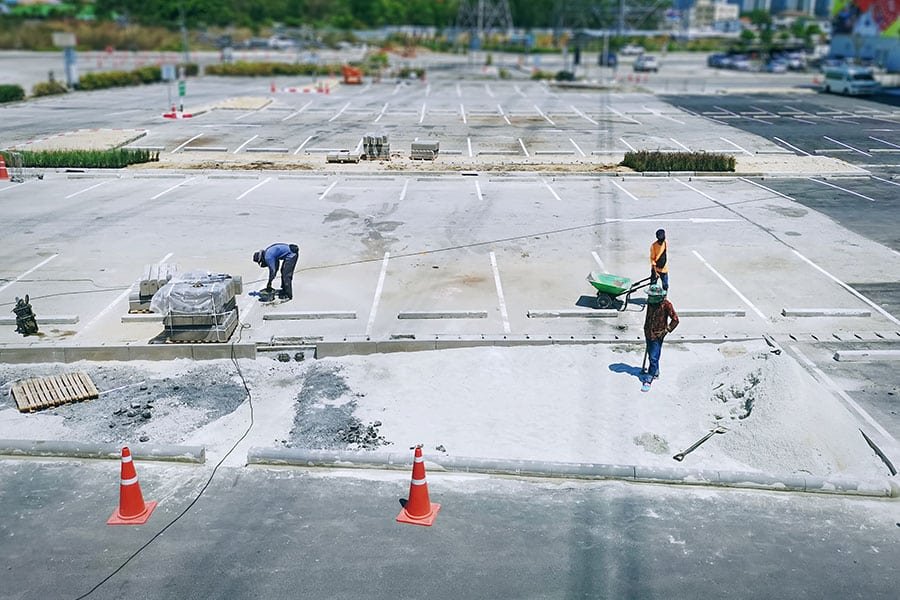
We build and rebuild commercial parking lots for retail centers, hospitals, schools, offices and apartment communities in the Pueblo metro. The work covers subgrade, base, asphalt or concrete paving, curb and gutter, sidewalks and ramps, drainage inlets, striping, wheel stops, accessible stalls and light pole bases. Done well, it is invisible. The lot just works, year after year, and the owner stops thinking about it.
Many of our parking jobs are on properties that stay open while we work. Retail centers do not want to lose a holiday weekend, and a medical campus cannot block an ambulance route. We phase the work to protect access and sales, and we put the schedule on paper so the property manager, the tenants and the construction trade partners all know which rows are closed and when they reopen. Planning that part carefully is half the job.
New lots, mill and overlay, and full rebuilds
New parking lots start with grading and drainage, then base course, paving, curbs and finishes. Existing lots fall into three categories. Some need only crack sealing, patching and striping. Some need mill and overlay, where we grind off the worn surface and place new asphalt. Others have base failures and need full-depth reconstruction, where we remove the pavement section and rebuild it from the subgrade up. Core samples and a walk of the lot tell us which one you are looking at.
We recommend the least expensive approach that will hold up, not the most expensive one. Resurfacing a lot with a failed base wastes money because the same cracks come back in a year or two. Rebuilding a lot that only needed an overlay wastes money too. We show the options with costs, explain the reason for each and include a repair map so you can see which areas get which treatment. Related truck court and apron work is priced separately so heavy-duty sections are built to the right standard.
Lots that serve different uses
A retail shopping center wants good circulation, visible entries and a surface that looks sharp. A hospital campus wants clear accessible routes, emergency access and lighting. A school wants separated bus loops and parent drop-off lanes. The paving section is similar, but the layout and the sequencing differ, and we plan each one around who uses it.
Structured parking has its own rules, and we handle that under parking structures. For surface lots, we also build the walks, ramps and crossings that make a site accessible, and we check slopes and cross-slopes against the accessibility standards before the concrete is poured. Getting a ramp slope wrong means tearing it out, and nobody wants to do that on a site that is already open to the public.
Pueblo lots and the traffic they serve
Interstate 25 exit 104 serves Dillon Drive and Drew Dix Parkway on the north side of Pueblo, and the SH 47 ramp to Mel Harmon Drive serves the mall directly. That kind of access means a lot of turning traffic, which is hard on pavement near entries and drive lanes. We reinforce entry throats and fire lanes where the design calls for it and make sure the lot geometry does not force vehicles to cut corners.
Pueblo's other big draws also generate heavy daily parking: UCHealth Parkview Medical Center, with 266 staffed beds and a helipad, and Colorado State University Pueblo, with 3,730 students enrolled in fall 2024. Hospital and campus lots run all day and into the night, so a closure has real consequences. We schedule work in quiet periods, such as summer for a campus, and keep patient and visitor routes clear around a medical center area at all times.
Permits, accessibility and drainage
Parking lot work usually needs a site or paving permit, and a new lot also triggers drainage and landscape review. The city of Pueblo says commercial approvals currently take about 75 days, and a rebuild that changes grades or adds impervious area can take longer. We confirm what applies before we price, and we prepare the submittal with your civil engineer if needed.
Accessible stall counts, van stall dimensions, route slopes, curb ramps and signage all have to meet the standard, and inspectors check them. We lay these out before paving so the stripes and signs go in once. Drainage matters as much as the pavement. Water standing on asphalt breaks it down quickly, so we shoot grades before paving and correct birdbaths while we can still fix them. The goal is a lot that drains the way the plan says, not one that looks fine dry and ponds in the first rain.
Costs that move the number
Asphalt prices change with oil and aggregate. Haul distance, area, thickness and access also move the cost. A lot with many islands and curbs costs more than an open one, and a small lot costs more per square foot than a large one because of mobilization. Base repairs, drainage fixes and lighting work are the extras that surprise owners most, so we ask for a core sample and a drainage walk before we quote.
The cheapest time to maintain a lot is before it fails. A retail chain managing dozens of sites often does better with a regular schedule of crack sealing and seal coat than with periodic full replacement. We can set up that kind of program across several properties, a practice that overlaps with multi-site rollouts. For a single owner, we provide a condition report with a ten year view of what will need attention and when.
Where we pave
We work across the Pueblo metro, from the city and Pueblo West to Florence, Penrose, Fowler and other Arkansas Valley towns. Distance affects mobilization, and asphalt has to be placed while it is hot, so we plan the plant and the haul before we commit to a start date. Where we can, we combine several small lots in the same area into one mobilization to save the owner money.
The Colorado State Fair Grounds at 1001 Beulah Avenue host year-round events in addition to the fair, and campus and fairground style properties have their own demands, with big gatherings and long periods of quiet. We schedule paving around those calendars. If your property has a seasonal rhythm, tell us at the start and we will work around it.
Get a lot condition report
We will walk your lot, take core samples and tell you whether it needs patching, an overlay or a rebuild, with a price for each so you can plan the spend.
Questions Owners Ask
Can you repave our lot without closing the whole thing?
Yes. We split the lot into sections, close one at a time and mark alternate routes for customers, staff and delivery trucks. It takes longer than closing everything, but it keeps the business running. We discuss the phasing with you and your tenants before work starts.
How do I know whether I need an overlay or a full rebuild?
Look at the cracking pattern and ask for cores. Surface cracks and light wear usually mean mill and overlay. Alligator cracking, rutting and soft spots point to base failure, and an overlay will not hold. We walk the lot, take samples and give you a map showing what each area needs.
How long before cars can drive on new asphalt?
Usually within a day or so, depending on the mix and weather. Concrete takes longer, often a week for light traffic. We barricade the area and tell you when it can reopen. Heavy trucks should wait longer, especially in warm weather.
Do you handle striping, signs and accessible parking layout?
Yes. We lay out stalls, accessible spaces, crosswalks and arrows, and install signs and wheel stops. We check counts and dimensions against the accessibility requirements before paint goes down so you do not have to restripe later.