
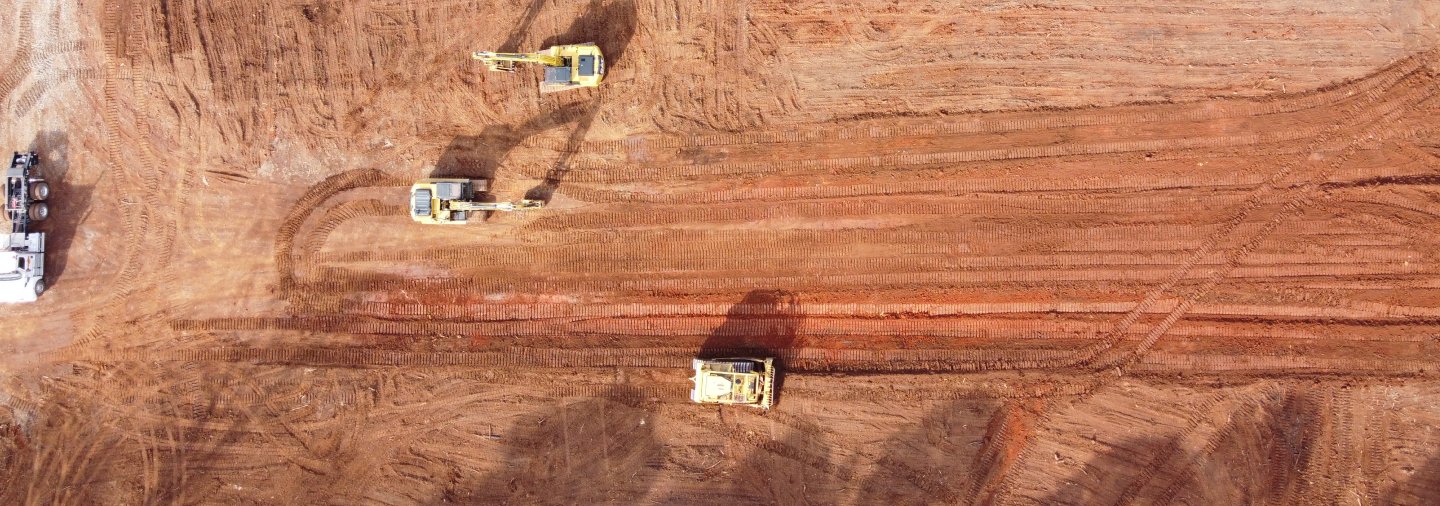
Mass Grading in the Pueblo Area
Mass grading and site preparation in Pueblo, Pueblo West and the Arkansas Valley, with plain pricing, honest soils assumptions and compaction you can document.
- Category
- General Contracting Services
- Area
- Pueblo and southern Colorado
- Next Step
- Request a Project Review
Forty acres with direct taxiway access are listed for development at Pueblo Memorial Airport, and a 1,111 acre parcel of the old Army depot east of town became PuebloPlex property in September 2025. Open ground like that does not turn into a building pad by itself. Someone has to strip it, cut and fill it, and leave a subgrade that a slab or a truck court can sit on for the life of the building.
We treat mass grading as the first real piece of work on a Pueblo job, not a subcontract we hand off and forget. That means survey control checked before the first pass, a cut and fill balance worked out on paper before we move dirt, haul routes that do not chew up the road we share with the neighbors, and compaction tests that are read and signed off before the next lift goes down.
If you are weighing a parcel at PuebloPlex or a lot in the Pueblo West industrial area, the grading number is usually the one that surprises people. We would rather give you a plain range early than a clean figure that grows after the first boring comes back.
Open land around Pueblo, and what it takes to use it
The city of Pueblo advertises the St. Charles Industrial Park as an Opportunity Zone with rail freight access, and says commercial and industrial construction here costs about 10 to 15 percent less than the national average. We believe the building side of that number. The ground side depends on the parcel. A flat lot with utilities at the street is one job. A raw tract on a former military reservation is another.
The PuebloPlex master plan covers a site of roughly 16,000 acres with more than 600 buildings plus utility and transportation systems already on it. Grading there is rarely clean-sheet work. You are working around existing roads, rail, underground lines and structures that were left in place, and you need to know what you are keeping before you cut. We walk the site with the owner and sort what stays from what goes before we price earthwork.
What a grading package covers
Our mass grading scope starts with clearing and stripping, then rough cut and fill to the grades on the civil set, then proof rolling, moisture conditioning and compaction of the building pad and pavement subgrade. We set the pad elevation with drainage in mind, so water leaves the site the way the engineer drew it. We also handle erosion control, construction entrances, haul road maintenance and dust control, because on a windy day those are what the neighbors notice first.
Utilities go in right behind the rough grade. We sequence trench work so the pad is not cut up again after it passes testing. If a site needs engineered fill, over-excavation or lime or cement treatment, that comes from the geotechnical report and not from our guess, and we price it as its own line so you can see it. We tie grading to stormwater and drainage work from day one, since detention and swales are cut during the same mobilization.
Questions to settle before the first pass
Three things move a grading budget more than anything else: how much material has to leave or arrive, what the soils report says about the top few feet, and how close the site sits to an existing road. Import and export means trucks, and trucks mean cost per load and time on public roads. We try to balance the site so the dirt we cut is the dirt we fill. When we cannot, you get that cost shown before you commit.
Ask for the geotechnical report before you close on a parcel, not after. We read it for bearing capacity, moisture content, any rock or cemented layers and recommended fill specifications. A site that looks identical to its neighbor can behave very differently under a compactor. If the owner is deciding between two lots, we will price both on the same assumptions so the comparison is honest. That kind of early look often saves more than any bid negotiation does later.
Earthwork windows and sequence
Grading is the work that gets squeezed when permits run late and the opening date does not move. The city of Pueblo says commercial approvals currently take about 75 days, so we plan around that. Where the permit allows early grading, we start under a limited release. Where it does not, we line up the equipment, testing agency and haul routes so mobilization happens the week the permit lands.
Dry weather is a gift on a dirt job and we plan to use it, but we do not bank on it. A pad that gets rained on mid-lift needs to be dried back and retested. We build slack into the earthwork duration, stage topsoil and stockpiles away from drainage paths, and keep the water truck on site. For industrial owners with a long-lead equipment date, grading and underground utilities come first, then concrete foundations, so the critical path stays in front of you.
Where grading money goes
Earthwork cost follows quantity, haul distance, soil type and how many times we have to touch the material. A site with a few feet of difference across it is cheap to balance. A site with a ten foot swing and no place to put the spoil is not. Pads for a manufacturing plant are the sensitive ones, because equipment loads are heavy. Fuel, equipment hours, testing and water also add up on a large pad, and we show them as separate lines rather than rolling everything into one lump sum.
The cheapest grading bid is often the one that left out the fill you will end up needing. We would rather carry realistic contingency for unknown soil conditions and tell you what it is for. If you run a logistics operation and are planning a warehouse building, or you are a manufacturer sizing a plant, give us the finished floor elevation, truck court slopes and detention requirements as early as you can. Those three items set the earthwork volume, and every change after they are fixed costs money.
Get a grading range before you buy the land
Send us the survey, the plan and the soils report, and we will give you a straight earthwork range with the assumptions listed. If the numbers do not work, we will tell you before you commit to the parcel.
Questions Owners Ask
How long does it take to rough grade a few acres of industrial land in Pueblo?
For a flat site with no import or export, a few acres of stripping, cut and fill and proof rolling is a matter of weeks, not months. Soil conditions, weather and testing turnaround decide the rest. We give you a duration with float built in and tell you which parts of it we cannot control, such as a rain delay or a failed compaction test that has to be redone.
Can we start grading before the building permit is issued?
Sometimes. Pueblo and Pueblo County each have their own review process, and a separate grading or site permit is often available ahead of the building permit. Because the city says commercial approvals take about 75 days, an early grading release can save real time. We check what your jurisdiction will allow before we promise a start date.
Who pays when the soil turns out worse than the report said?
That depends on the contract, so we write it clearly before work starts. We carry an allowance or unit price for unsuitable material and over-excavation, and we document anything we find with photographs and test results. If conditions differ from the report, you see the quantity and the price before we proceed, not on the final invoice.
Do you handle erosion and dust control, or does the owner arrange that?
We handle both as part of the grading package. Perimeter controls, construction entrances, water trucks and stabilization of finished areas are in our scope, along with inspection of those measures after storms. A dry, windy site can create complaints fast, so we treat dust as a daily task, not an afterthought.
What do you need from us to price mass grading accurately?
A current survey, the civil drawings or at least a preliminary site plan, and the geotechnical report if one exists. If you do not have a soils report yet, we will tell you which borings to ask for. The finished floor elevation and truck court layout matter most, because they set how much dirt moves.